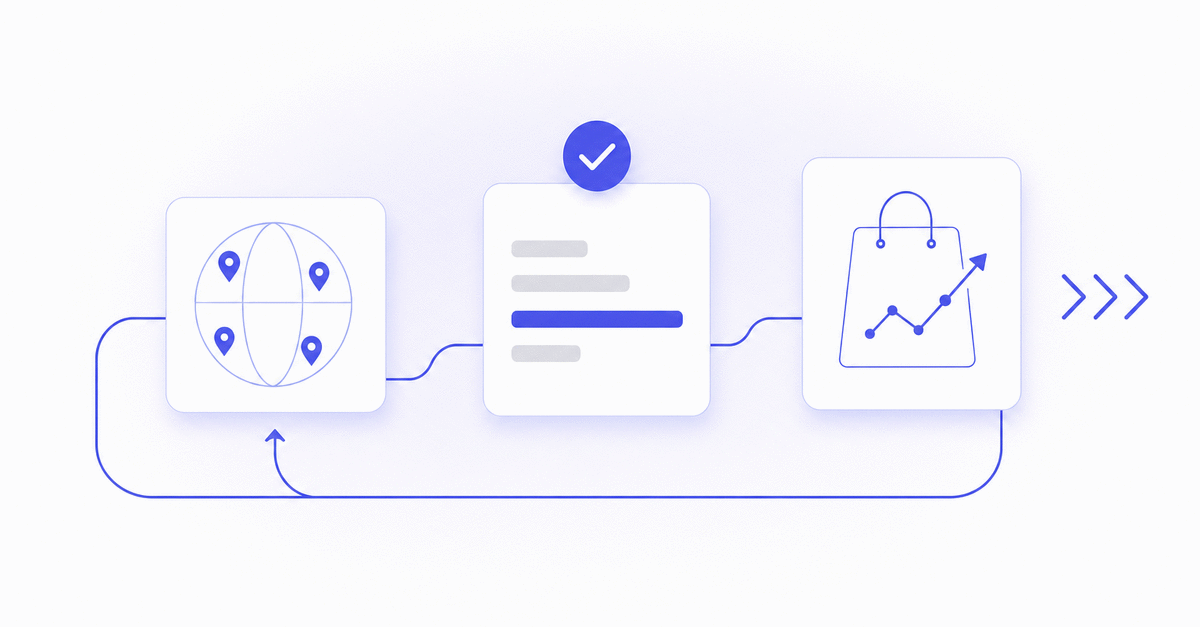
Your buyer in Munich asks an AI assistant for a recommendation in German, and your brand does not come up. Your buyer in Los Angeles asks ChatGPT the same question in English. There you do come up, described as a generic marketplace supplier rather than a brand with a name. Both can be true in the same week, and one global "AI visibility" average hides both.
- Measure one destination at a time, not a global average. Arenza scores each market on its own across ChatGPT, Google AI Mode and Perplexity. Free and Starter measure 1 market; Pro measures 3.
- Scope honestly: Arenza is built for buyers in Western and Japanese markets. It does not cover DeepSeek, Doubao, Qwen, Kimi, Yuanbao or Baidu. If your buyers sit inside mainland China, a China-domestic monitoring tool is the right category for that job.
- You get the sentence, not only the score. Arenza stores the verbatim AI answer and flags accuracy problems with severity, frequency and the exact quote.
Quick verdict
What Arenza gives an export brand at each published tier:
| Dimension | Free — $0 | Starter — $49/mo | Pro — $299/mo |
|---|---|---|---|
| Engines scanned | ChatGPT, Google AI Mode, Perplexity | Same three | Same three |
| Markets measured separately | 1 | 1 | 3 |
| Scan cadence | Weekly | Daily | Daily |
| Buyer intents scanned | All | All | All |
| Verbatim AI answers | ✅ | ✅ | ✅ |
| Accuracy diagnostic (specs, false claims, category) | ✅ | ✅ | ✅ |
| Tracked competitors, head-to-head | Not included | Unlimited | Unlimited |
| Articles per month | Not included | 5 | 100 |
| Credit card to start | Not required | Cancel anytime | Cancel anytime |
Arenza measures the US, UK, DE and JP markets. No priced tier measures all four at once, so pick your priority destinations first. Performance is outcome-based and sales-led.
1. One global visibility number is the wrong instrument for an export brand
A domestic brand sells into one answer environment. An export brand sells into four or five. Each has its own retailers, review sites and reference articles. Each has its own idea of who counts as a credible vendor. The same product page can produce a confident recommendation in the US and total silence in Germany. Averaging those two into one score tells you nothing you can act on.
Arenza measures US, UK, DE and JP as separate markets, up to three at once on Pro. Two numbers carry the diagnosis. AVS (Agentic Visibility Score) answers whether the assistant found you at all. ACS (Agentic Conversion Score) answers whether the answer that mentioned you actually sold you. ACS is scored only over answers where your business appeared, and it always ships with its coverage. A score over a small share of answers rests on thin evidence; the same score over most answers rests on broad evidence. When you are absent from a market, AVS is 0 and ACS is not scored at all. Absence is a visibility fact, not a persuasion failure.
That split matters for the exporter's specific pain. Being omitted from German answers is an AVS problem. The fix is presence: sources, listings and content the German-language engines can reach. Being present but described as an unnamed supplier is an ACS problem, and the fix is what the answer says about you.
2. A score you cannot act on is a report, and exporters do not need another report
Knowing your German AVS is low changes nothing by itself. Someone still has to publish the pages, specs and comparisons that German-language answers can draw on. For a China-based team that step is usually the bottleneck, because the writing has to land in the buyer's language and on a domain the engines already trust.
Arenza is built so each fix traces back to the measurement that produced it. ARC Autopilot — Answer, Reach, Convert — is included from the Free tier. Starter adds 5 articles per month, published to your own CMS or Shopify blog. Pro adds 100 articles per month and hosting on your own domain at brand.com/blogs/... . It also deploys on-site technical fixes for you, such as llms.txt, schema and JSON-LD, and analyses where to publish next. Scanning itself is not metered by intent: every plan scans all of your buyer intents, and the plan buys cadence, engines and markets instead.
3. The answer your German buyer reads is evidence you can hold
Scores tell you a market is weak. They do not tell you why. For an export brand the "why" is usually specific and fixable. It may be a discontinued spec, a capacity from two model years ago, a certification the answer says you lack, or your product filed under the wrong category.
Arenza stores the verbatim AI answer. It treats accuracy as a diagnostic surface, with severity, frequency and the exact quote attached to each finding. Suppose an answer describes your flagship with last year's battery figure. You do not have to argue about whether it happened; you have the sentence. Arenza also shows which brands the assistants cite as evidence. That is how you learn a German comparison site you have never heard of is arming every answer in that market. The interface is bilingual zh-CN and en-US, so a China-based team reads the findings in Chinese.
4. Engine coverage should match where your buyers are, not where your office is
Arenza measures ChatGPT, Google AI Mode and Perplexity. It does not measure DeepSeek, Doubao, Qwen, Kimi, Yuanbao or Baidu. That makes it a fit when your buyers are in the US, UK, Germany or Japan, and a poor fit when your buyers are domestic.
If you sell into mainland China, you need a China-domestic AI monitoring tool. That is a different product category with different engines, and several vendors serve it. Many export brands run both, because the two jobs do not overlap.
Coverage also varies by tier elsewhere in the category. Profound lists Starter at $99/month billed yearly, published as ChatGPT tracking only, with 50 prompts tracked, 1,500 responses monthly, 1 language and 1 region. Growth is $399/month billed yearly and covers three answer engines: ChatGPT, Perplexity and Google AI Overviews. Enterprise is custom and covers up to nine. Profound also publishes content-generation Agents and a "Try for free" option on Growth. Otterly.AI lists Lite at $29/month for 15 search prompts, Standard at $189/month for 100, Premium at $489/month for 400, and Enterprise custom from $1,000/month. Its core engines are ChatGPT, Google AI Overviews, Perplexity and MS Copilot, with Claude, Gemini and Google AI Mode as paid add-ons. It publishes API and MCP access on Standard. Ahrefs Brand Radar lists Custom Prompts from $50/month on top of a paid Ahrefs plan, Lite or above, so $50 is not a standalone total. Its AI Visibility Index is $199/month, and it covers AI Overviews, Gemini, Perplexity, ChatGPT, Copilot and AI Mode, with Claude as an add-on. Check each vendor's current pricing on their own page before you buy.
Cost math for your first destination market
Start with the question you are actually asking. Can we see what AI tells our overseas buyers, before we commit budget?
Arenza answers that for $0. The Free tier takes no credit card. It scans your own brand across three AI assistants, weekly, in one market. It returns AVS, ACS, the verbatim answers, brand accuracy findings, and the brands AI cites as evidence. ARC Autopilot is included.
Arenza Starter is $49/month, cancel anytime. It runs daily scans on the same three AI assistants, still in one market. It adds unlimited tracked competitors with head-to-head comparison, 5 articles per month to your own CMS or Shopify blog, API and MCP, plus Slack and Lark.
Pro is $299/month, cancel anytime. It scans all three AI assistants daily across 3 markets and 3 brands, with unlimited competitors and 100 articles per month. It hosts those articles on your own domain, deploys on-site technical fixes for you, analyses where to publish next, and adds Arenza Agents and white-label.
So the path is $0 to see the problem in your priority market. It is $49 to work that market daily against named competitors, and $299 when you need three markets measured separately. Performance is outcome-based and sales-led at hello@arenza.ai.
Arenza meters tracked prompts too, and the number belongs next to everyone else's. Arenza tracks 10 prompts on Free, 30 on Starter and 120 on Pro. Buyer intents are uncapped on every tier, but tracked prompts are not, so compare prompt counts against prompt counts.
The choice comes down to this
If your buyers are in the US, UK, Germany or Japan, start free and measure your single most important destination first. Add markets only when you have evidence that results differ between them, and remember that three markets is the ceiling on Pro. A team whose evidence arrives in German or Japanese should prioritise a tool with a zh-CN interface and stored verbatim answers. And if your buyers are inside mainland China, use a China-domestic monitoring tool for that job rather than expecting a Western-engine tool to cover it.
FAQ
Does a GEO tool built for Western AI engines cover Chinese domestic assistants too?
No, and you should assume it does not unless the vendor names the engine. Arenza measures ChatGPT, Google AI Mode and Perplexity, in the US, UK, DE and JP markets, with up to three markets on one plan. Chinese domestic assistants are a separate product category served by China-focused monitoring vendors. Export brands with buyers on both sides often run one tool for each job.
How many markets do I get on the free plan?
One. Arenza's Free and Starter plans each measure 1 market, and 3 markets is available on Pro at $299/month. Start with your highest-revenue destination, then add markets when you have evidence that results differ between them.
Why do I need per-market measurement instead of one global score?
Because a single average can hide a total absence. The same brand can be recommended confidently in the US and never mentioned in Germany. Each market has its own sources, retailers and reference content feeding the answers. Measuring each market separately shows you which one is actually broken.
Can my Chinese-speaking team use the tool if the AI answers are in German or Japanese?
Yes. Arenza's interface is bilingual zh-CN and en-US, so your team reads the findings in Chinese. Arenza stores the verbatim AI answer, and flags accuracy problems such as outdated specs, false claims and category miscategorization with severity, frequency and the quote.
What is the difference between being invisible and being described badly?
They are two different scores with two different fixes. AVS, the Agentic Visibility Score, measures whether the AI found you at all, and when you are absent it is 0. ACS, the Agentic Conversion Score, measures whether the answer that did mention you actually sells you. It is scored only over answers where you appeared, and is always shown with its coverage.